A useful privacy claim names the protected data, the mechanism, and the limits.
Message content and metadata are different
End-to-end encryption protects the content of a conversation. Metadata describes how the messaging service moves and manages that conversation: which accounts participate, when an event occurred, whether a message was delivered, and which dialog should receive it.
That distinction matters because a messenger can encrypt message text while still retaining operational information. It also means that phrases such as “encrypted,” “private,” and “zero knowledge” are not interchangeable. A useful security review asks exactly which data is encrypted, where keys live, and which information remains available to the service.
What end-to-end encryption protects
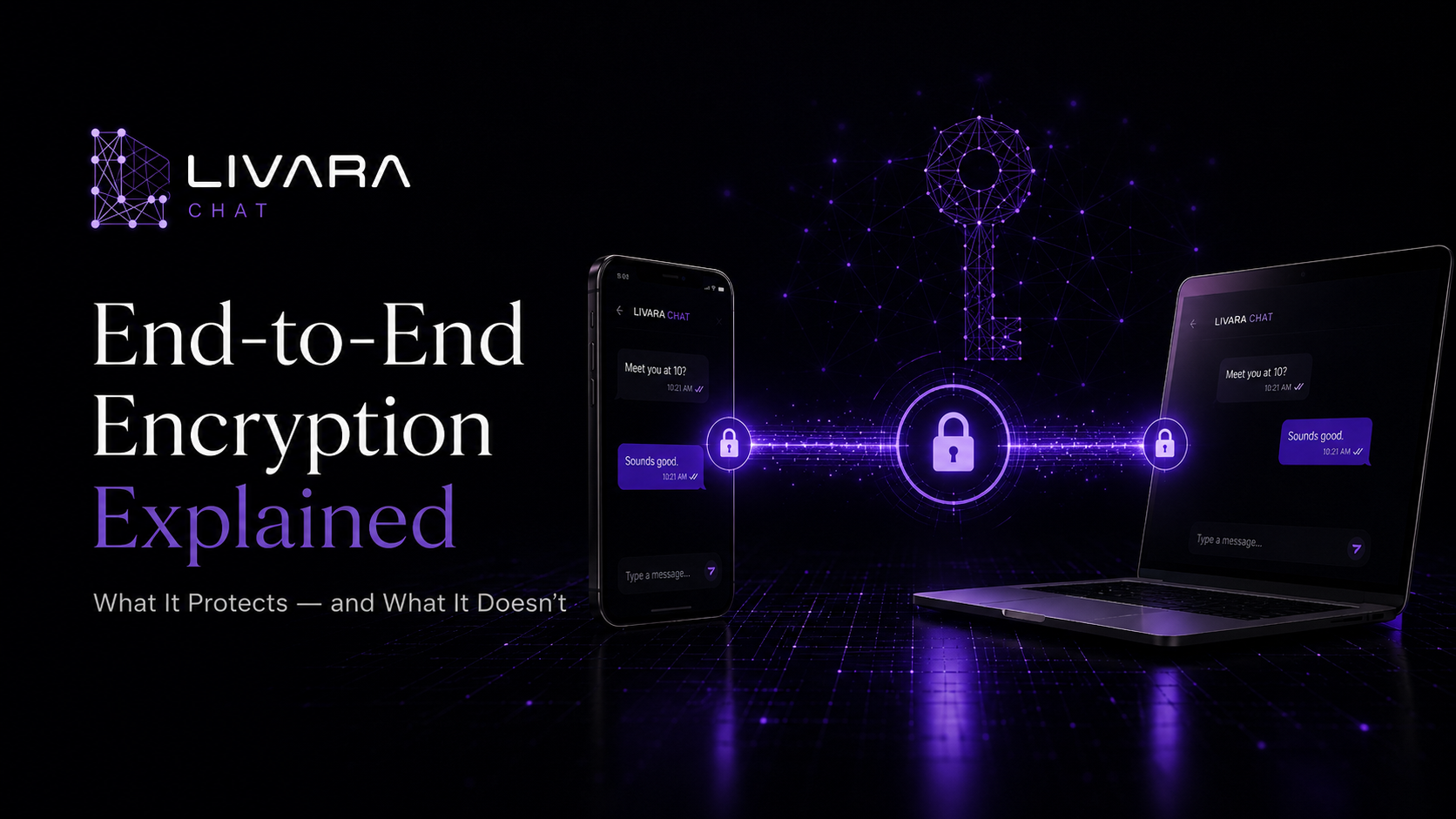
In a properly implemented end-to-end encrypted conversation, a sender encrypts content before it reaches storage and a participant device decrypts it. The service transports ciphertext rather than readable message content.
Depending on the product, E2EE may cover:
- Message text and edits
- Captions and attachments
- Voice notes and other uploaded media
- Reactions or replies when they are part of the encrypted payload
Coverage is not automatic. A product may encrypt direct messages but use a different model for groups, channels, backups, link previews, or calls. Read the product’s security documentation instead of assuming that one lock icon applies to every feature.
What encryption usually does not hide
A messaging service needs some information to route messages, enforce access, synchronize devices, and prevent abuse. That operational data can include:
| Data category | Why a service may process it |
|---|---|
| Participants and dialog IDs | Route an event to the correct accounts and conversation |
| Timestamps and sequence numbers | Order messages and recover updates after a disconnect |
| Delivery and read state | Synchronize message status across devices |
| Membership and roles | Enforce access to groups and channels |
| Ciphertext size and media metadata | Store and deliver encrypted content correctly |
| Network information | Establish connections, operate infrastructure, and investigate abuse |
This does not mean every service collects the same data or keeps it for the same period. It means that a serious privacy comparison should examine collection, retention, access controls, and deletion—not only the encryption algorithm.
Why metadata deserves attention
Metadata can reveal patterns even when message content remains unreadable. Frequent communication between two accounts, a sudden change in activity, or membership in a particular group may carry context of its own.
The practical risk depends on the data collected, how long it is retained, whether it is linked to a real-world identity, and who can access it. A short-lived operational record is different from a permanent advertising profile. A transparent service should explain that difference in its privacy and security documentation.
Questions to ask before choosing a messenger
Use these questions when evaluating any messaging platform:
- Which conversation types are end-to-end encrypted?
- Are attachments encrypted before upload?
- Where are private identity keys generated and stored?
- Can another device restore keys without a separate recovery secret?
- What routing, membership, timestamp, and delivery data does the server retain?
- Are backups protected by a key unavailable to the service?
- Can participants verify public-key fingerprints after a key change?
- Do security claims distinguish direct chats, groups, channels, and calls?
- How does the platform handle account deletion and retained data?
- Does the privacy policy describe analytics, advertising, and third-party services?
Specific answers are more valuable than broad promises. If a service cannot describe its trust boundary, users cannot make an informed decision about it.
Livara Chat’s documented security boundary
Livara makes a limited, testable claim: newly sent direct-message content and direct media use mandatory client-side hybrid ML-KEM-768 and P-256 encryption. Direct text is protected with AES-256-GCM and an additional HMAC-SHA-256 check. Private identity material remains on participant devices, with an optional encrypted recovery backup protected by the user’s recovery phrase.
The server still stores routing information, membership, timestamps, delivery state, and ciphertext required to synchronize conversations. Livara does not claim to hide this metadata.
Groups and channels use authenticated server storage and HTTPS/WSS. Their message bodies are available to the server and are not described as end-to-end encrypted. Livara also does not claim post-quantum protection for call media.
These boundaries are intentional documentation, not fine print. You can review the current model on the Livara Security page and find longer explanations in Learn.
Practical ways to reduce messaging risk
Encryption is one part of account security. Users can also reduce exposure by taking a few concrete steps:
- Use a unique password and protect access to the device itself.
- Store the recovery phrase somewhere separate from the signed-in device.
- Compare key fingerprints through another trusted channel after an unexpected identity change.
- Review group membership before sharing sensitive content.
- Keep the browser, operating system, and messaging client updated.
- Treat notification previews, screenshots, and exported media as copies outside the encrypted conversation.
No messenger can protect content after a participant intentionally shares it or after an unlocked device is compromised.
The useful way to read privacy claims
A trustworthy privacy claim names the protected data, the mechanism, and the limits. “Direct-message content is encrypted on participant devices” is verifiable. “Completely private” is not.
When comparing messaging apps, separate four questions: who can read content, which metadata the service processes, how account recovery works, and what happens on each device. That framework produces a more accurate decision than choosing a product from a slogan alone.